
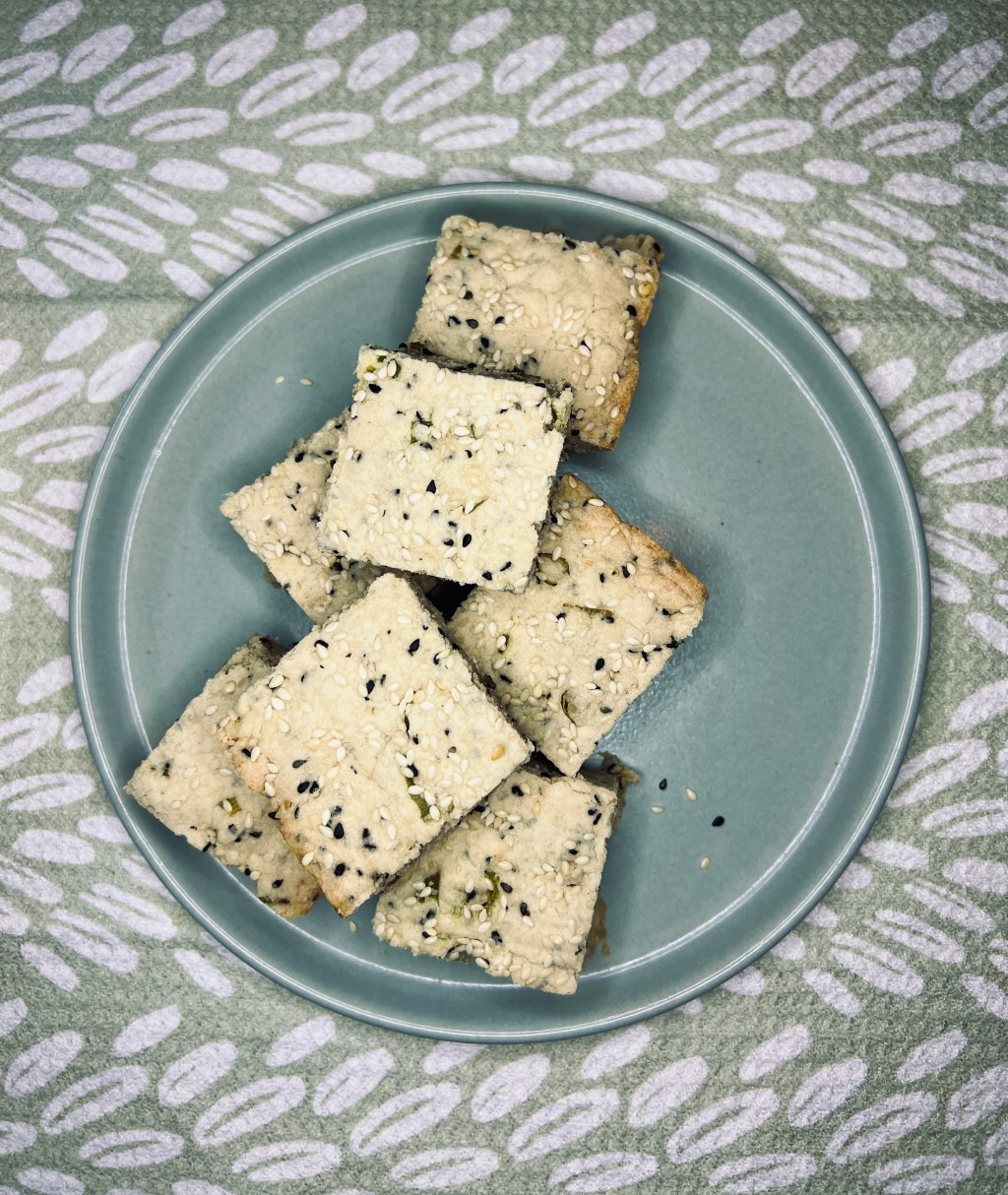
So far in this savory cookie journey, I’ve encountered a wide variety of savory ingredient additions. In some recipes, seeds and nuts are responsible for providing an earthy, toasted quality. In others, alternative flours like buckwheat or corn introduce texture and complex flavors. Sometimes, dried chili peppers bring the heat. Other times, the addition of cheese is what pushes an otherwise sweet treat into savory territory. But one thing I have yet to encounter, is the addition of one of my favorite savory ingredients: alliums. Enter: Jesse Szewczyk’s Sesame-Scallion Shortbread Squares.
Another recipe from the Savory chapter in Szewczyk’s cookbook, Cookies: The New Classics, these shortbread squares double down on alliums, including both scallions and garlic. These alliums, alongside sesame seeds and sesame oil, are what transform otherwise ordinary shortbread into a salty, slightly sweet, certified savory snack.
Alliums are an extremely broad category of plants. The allium family (or if you want to be scientific about it, genus) includes a number of culinary staple ingredients like onions, garlic, scallions, chives, shallots, and leeks, as well as dozens of wild species, many of which are forageable (think ramps and field garlic). All in all, alliums boast nearly 1000 species, one of the largest groups of plants in the world.
When it comes to uses, alliums also take the cake in versatility. Medicinally, alliums have been used for their anti-inflammatory and anti-microbial properties. Culinarily, alliums can add a variety of different flavors and textures depending on the method of preparation. In their simplest form, raw alliums add a sharp, biting flavor and crunch. Grated or minced, the resulting paste will more easily break down when sauteed, adding another layer of depth that can stand up to acidic flavors. Alliums can be fried for added crunch, charred until softened and mellowed in flavor, or slow roasted/sauteed until you are left with a rich, caramelized substance that melts in your mouth like butter.
Many of allium’s special skills can be attributed to one special compound: allicin. Allicin is a bioactive compound present in alliums. It is extremely reactive, so any type of processing (e.g. chopping, mincing, cooking, etc.) can result in chemical reactions that modify the plant’s properties. For example, when you chop an onion and damage the cell walls, an enzyme called alliinase is released and causes a chemical reaction that produces the compound syn-propanethial-S-oxide, which is what makes you cry. Introducing heat will cause those same compounds to break down, transforming the flavor of alliums, like when you roast garlic and it goes from pungent and biting to buttery and sweet.
The science behind alliums is what makes them a culinary powerhouse. Even the way you slice an onion can drastically alter the final product (see Chef Michael Chao’s explanation of how cutting with vs. against the grain results in different textures that lend to different uses, e.g. pickling vs. caramelizing). The myriad of alliums in existence and their innumerable applications likely explains why they are found in nearly every cuisine and culture. Not to mention, alliums are delicious, something we can all get behind.
Which brings us back to the recipe at hand: sesame-scallion shortbread. The recipe calls for sliced scallions (aka green onions) and grated garlic. Both of these alliums, when baked, soften, mellow, and sweeten in flavor. However, because they are never in direct contact with the heat, having been encased in a buttery dough, they never reach full caramelization and retain a fair amount of their trademark pungency. When combined with toasted sesame oil, sesame seeds and a scant amount of sugar, the final result is decidedly savory.
One takeaway from this recipe, however, is that I wouldn’t recommend substitutions. Namely those of the vegan variety. Specifically, plant-based butter.
When it comes to baking, I have experimented here and there with plant-based alternatives. However, my preference is to make a recipe as written, including the recommended ingredients. This is primarily to maximize my chances at success. Especially now that I have started to attempt recipe development myself, I recognize the risk of untested substitutions and the impact (potentially negative) that they can have on your final product. There are many great vegan recipes out there that were designed to be 100% plant-based or were developed and tested with vegan substitutes in mind. In hindsight, I maybe should have looked for a recipe that fell into that category.
However, I did not, and I decided to test my luck with the internet’s most highly recommended plant-based butter: Miyoko’s european style plant milk butter, made with a combination of cashew and coconut oil. In my mind, it was an opportunity to satisfy both a friend’s dietary restrictions and my curiosity. I’ve never used plant-based butter before in baking, much less in a recipe where the main ingredient is butter. Would it work?
When I first unwrapped it, I was pleasantly surprised. Though it lacked the distinct soft yellow hue, texturally it was close. It was a bit quicker to soften than its animal-based counterpart, which was nice because the recipe called for softened butter and I notoriously never take out my butter early enough to let it soften gradually. Instead, I usually fall back on a high-risk, high reward maneuver: microwaving a cold stick of butter in short bursts until the butter is perfectly room temperature. One second too late, though, and you may find yourself with a puddle of melted butter. As a fairly risk averse person, this is probably the closest I will ever get to gambling.
The final result was an easy to work-with shortbread dough, studded with scallions and black and white sesame seeds. As I put it into the oven, I was pleased that the substitution appeared to have gone off without a hitch.
But, as the old adage goes, the proof of the pudding is in the eating. Yes, that is the original saying, and yes, I only learned that upon writing this post.
I wouldn’t go as far as to say that the final shortbread squares were bad. They had many positive qualities: they were crumbly and savory with the right amount of salt. But they did lack a certain depth of flavor that you can only get from the Maillard reaction of browning milk solids in animal-based butter. The final shortbread squares were a bit one-note and noticeably paler in color (although this might have been remedied by baking for longer or hotter – if anyone else tries it, you will have to let me know).
One criticism that stands regardless of substitutions is the square format. The recipe called for an 8×8 inch square pan which resulted in thick cubes of shortbread that were more scone or biscuit than cookie. Next time, I might opt for a log-and-slice technique or a larger pan for a shorter, crisper cookie. Alternatively, you could whip up some charred scallion butter and serve it on the side as a spread to combat the density and dryness.
I can’t say I’m surprised that vegan butter didn’t fully deliver in a recipe as butter-forward as shortbread. But it was a worthwhile experiment that helped reinforce the importance of critically examining potential tradeoffs when substituting key ingredients. It also reminded me of the endless possibilities that alliums present in a savory baking context, both traditionally (think leek galette) and experimentally (did someone say caramelized onion shortbread?)
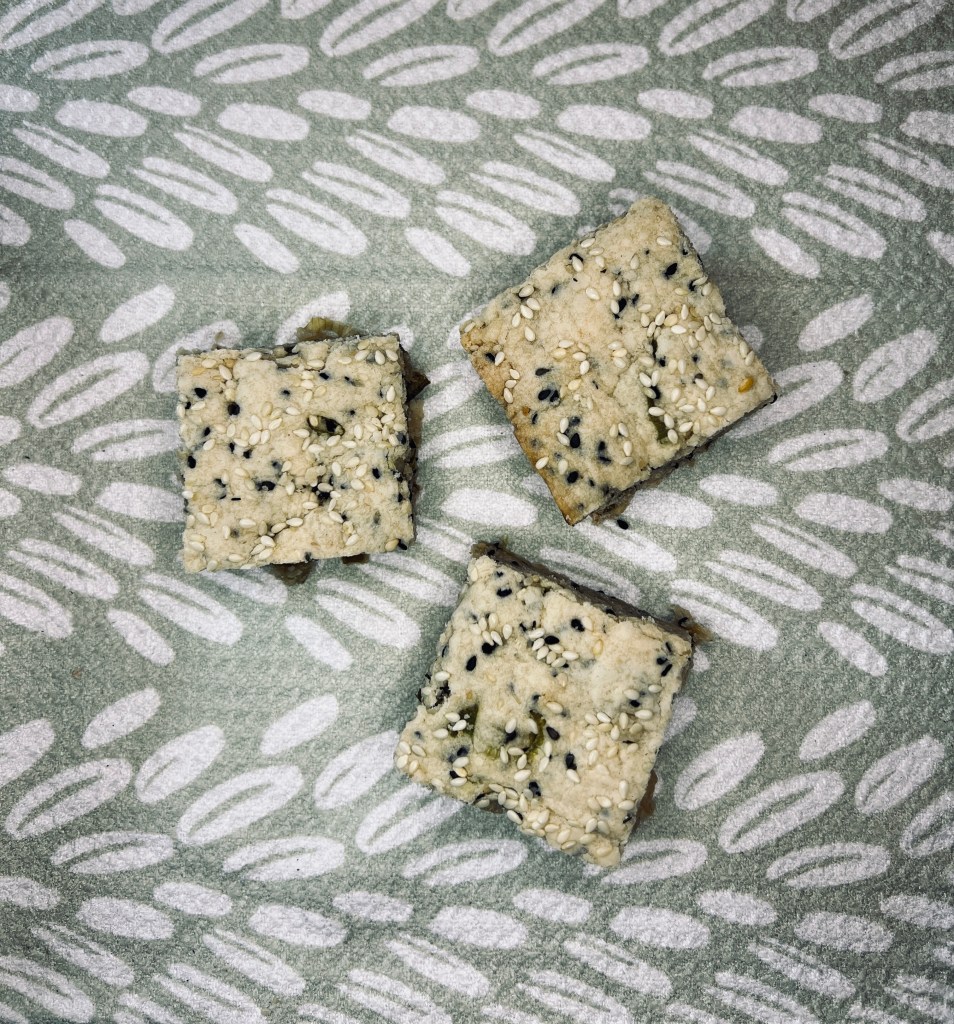
| savory-ness (1-5) | 4 – alliums amped it up! |
| weird or works? (complimentary flavors or a little bit weird?) | works! |
| savory ingredients highlights | scallions + garlic + toasted sesame oil + black and white sesame seeds |
| best served… | with a side of whipped scallion butter |
| encore? | yes!* *with real butter |

 Savor Tooth Snacks
Leave a reply to tahini raspberry blondies – Savor Tooth Snacks Cancel reply