
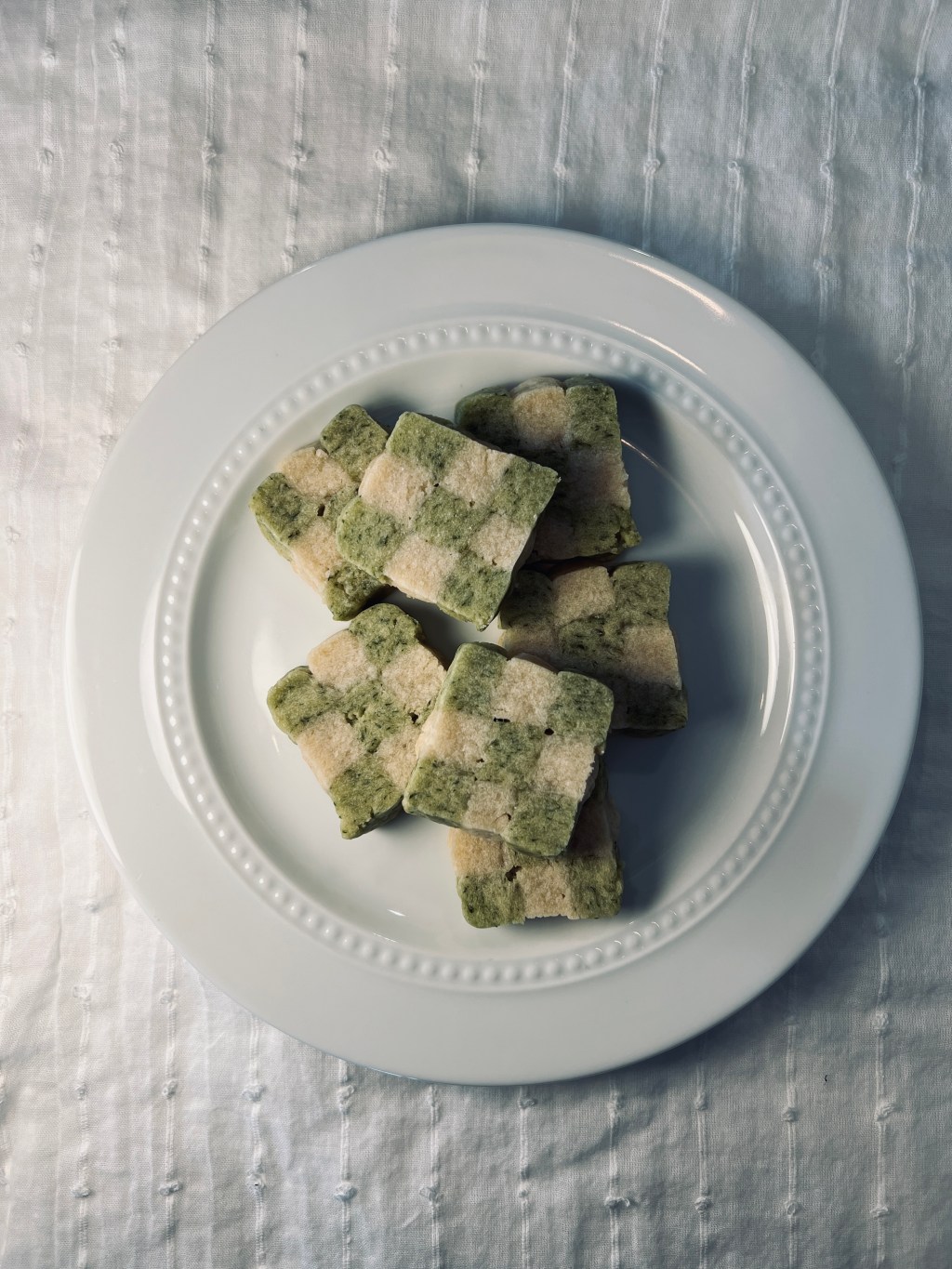
One aspect of this project which I’ve alluded to on a few occasions (here and here) is new recipe development. Coming up with and testing an original recipe has proven to be challenging, and so far, I haven’t made anything I felt was ready to share. Until now. Meet the first Savor Tooth Snacks original: Basil Parmesan Checkerboard Cookies.
To make these cookies, I took my own advice and followed My Blueprint for Recipe Development*:
Step 1: Come up with a vision.
My goal when developing new recipes has been two-fold: 1) deliver exciting, savory flavors and 2) make each cookie a work of art. A successful recipe, in my book, would deliver a feast for the tongue and the eyes.
Inspiration on how to achieve both hit when I saw NYT Cooking’s recipe for Neapolitan Checkerboard Cookies – cubes of strawberry, chocolate, and vanilla shortbread perfectly aligned to create a checkerboard pattern. I took one look and asked myself: what if I took that, but made it savory?
I glanced up and the first thing I saw was my Aerogarden overflowing with fresh basil. And what pairs better with basil, than parmesan? A vision of a white and green checkerboard appeared in my mindseye. Pesto Shortbread was born.
Step 2: Research.
When it came to making these cookies, most of it seemed fairly feasible. There are lots of reference points for cheese in shortbread: Rachel Gurjar’s Chili-Cheese Cookies or Jesse Szewczyk’s Cacio e Pepe Slice-and-Bakes. To create the checkerboard pattern, I planned to follow the method outlined in the NYT original: roll, slice, assemble with a little egg-white-wash, and slice again. The one piece that had me stumped, however, was how to incorporate fresh basil into shortbread while maintaining both its herbaceous flavor and its bright green color.
Some Googling led me to a few suggestions:
- Basil-sugar
- Basil-butter
Both techniques utilize a food processor to macerate the basil and combine it with another ingredient that one would already find in a shortbread cookie: sugar or butter. I went with the sugar as it seemed more likely to yield a uniform distribution of basil and fewer large flecks. I hoped the sugar would act as another coarse agent to break down the basil into a wet, sugary emulsion.
Step 3: Decide what you want to change.
I started with a trustworthy basic shortbread recipe from the one and only Sohla El-Waylly (I HIGHLY recommend her cookbook, Start Here).
My reference recipes for cheese shortbread indicated that I’d need to compensate for the additional fat of the cheese by adding a bit more flour. Common sense told me that the addition of a fresh herb like basil would also need to be balanced out with some more flour, but not quite as much.
Otherwise, I didn’t plan on messing with any of the other ingredients in the recipe: same amount of salt, butter, and sugar. Keep it simple.
Step 4: Bake in small batches.
For this recipe, I knew I had a limiting ingredient that would determine the minimum batch-size: basil-sugar. Not wanting to risk improper-emulsification of the basil and sugar by putting in too scant an amount in my food processor, I opted for the ¼ cup sugar recommended by my base recipe and went from there.
Step 5: Write it down.
Enter: the trusty spreadsheet. I was able to write out the measurements from several different inspiration recipes to help inform my final ratios. I determined that I’d need to increase my flour by 25% in order to compensate for the amount of cheese I was planning to add and I added two tablespoons of additional flour to my basil shortbread, guessing that was what it would take to balance out the additional 1-2 teaspoons of water from the fresh basil.
Step 6: Be flexible.
Along the way, I reminded myself that if things didn’t work out according to plan, that was OK. At the very least, I would learn something and be able to apply it to the next version. Fortunately, however, this recipe really went off without a hitch! No pivots required.
*Disclaimer: Just like following a recipe doesn’t always mean you will be rewarded with a delicious treat, following this process doesn’t guarantee your recipe development journey will be a success. It might, however, increase your odds.
When these cookies came out of the oven, I was thrilled. The entire kitchen smelled like an Italian Nonna had been at work making pesto pasta – the shortbread smelled like warm butter, fresh basil, and salty parmigiano reggiano.
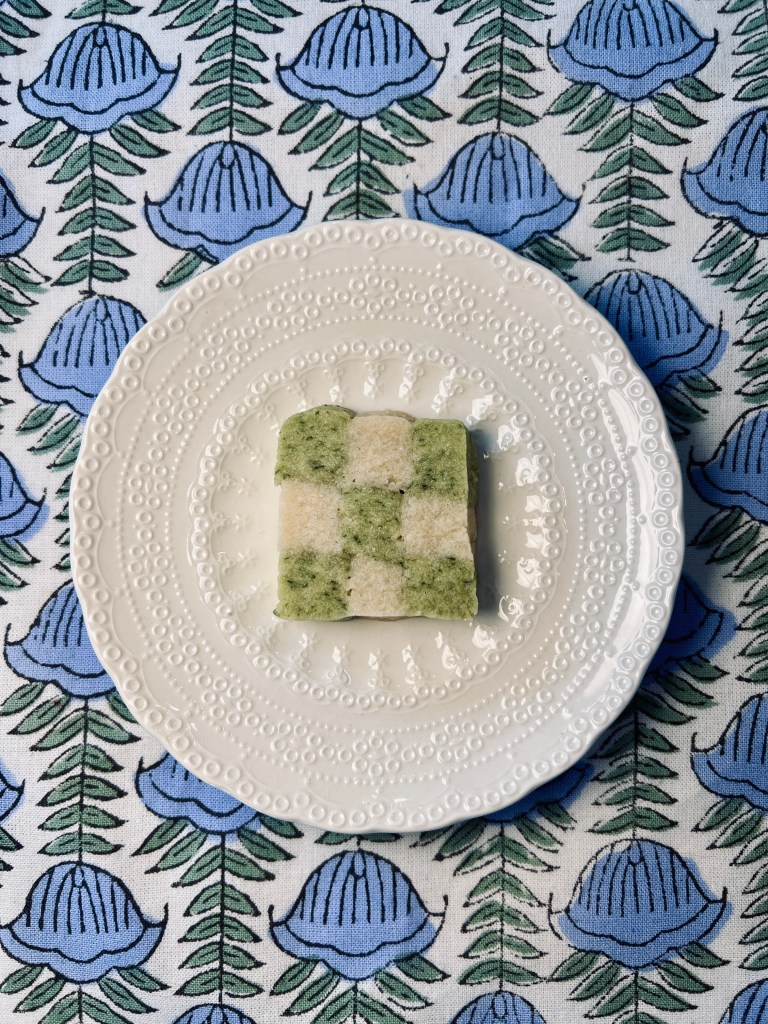
Each cookie was a geometric masterpiece made up of 9 tiny squares, alternating between pale green and off-white. You could break the cookie in half, or break off an individual cube to try each flavor independently. Lined up next to one another, the cookies looked like green-and-white gingham. The embodiment of a spring picnic, cherry blossoms, and freshly sprouted blades of grass.
Biting into it, however, you found yourself transported to Italy, land of pesto alla genovese. The shortbread is delicate and buttery, and each bite you can taste the salty punch of parmesan, followed by the bright, peppery basil. The sweetness of the herb is amplified by the small amount of sugar in the cookie. However, there is no question: these cookies are savory.
Being able to take an idea and manifest it into reality was a huge confidence boost. I am eager to build on this small success and try my hand at developing more recipes, and hopefully share them here. Still, I know that this recipe was a rare, hole-in-one. Future recipes may take more trial and error. And that’s OK!
For now, I’ll enjoy the win, pour myself a glass of Pinot Grigio, and snack on some pesto shortbread.
| savory-ness (1-5) | 4.5 – cheesy parm + bright basil bring a pesto flavor |
| weird or works? (complimentary flavors or a little bit weird?) | works! |
| savory ingredients highlights | basil + parmesan |
| best served… | on a spring picnic while you day-dream of pesto pasta in the Italian countryside |
| encore? | check-yes! |
Basil Parmesan Checkerboard Cookies aka Pesto Shortbread
This recipe puts a savory spin on shortbread, packaging the classic flavors of fresh pesto – basil and parmigiano reggiano – into one bite. Each checkerboard cookie is a mini geometric masterpiece, and tasty, too! Bring these aesthetic treats to your next picnic and savor each buttery, herbaceous, cheesy bite.
Kitchen Equipment
- Kitchen scale – this will help ensure precise measurements and a foolproof bake!
- Food processor – used to process the basil sugar and finely grind your parmesan cheese
- Stand-mixer or hand-mixer – this recipe could be mixed by hand, but a electric mixer (stand or hand) will ensure all ingredients are evenly incorporated
- Metal ruler – this will help you measure and slice the shortbread to assemble into a checkerboard pattern
- Pastry brush – used to apply the egg-white wash when assembling the checkerboard cookies
Ingredients
For the basil shortbread
- 1 stick butter, room temperature
- 50 g (¼ cup) granulated sugar
- 1/4 tsp salt
- 140 g (1 cup + 2 tablespoons) all purpose flour
- 1 cup packed fresh basil leaves
For the parmesan shortbread
- 1 stick butter, room temperature
- 50 g (¼ cup) granulated sugar
- 1/4 tsp salt
- 150 g (1 + ¼ cup) all purpose flour
- 4 oz parmesan cheese
For assembly
- 1 egg white
- 1 tablespoon water
Instructions
For the basil shortbread
- Using a food processor, pulse the basil leaves and granulated sugar until fully combined. You should have a wet, dark green sugar paste. Transfer to a bowl.
- In a stand mixer, combine the butter, basil-sugar, and salt. Using the paddle attachment, beat on medium-high speed until fully combined, ~1-2 minutes. Scrape down the sides with a spatula half-way through.
- Add the flour to the stand mixer and mix until the flour and wet ingredients are just combined, resulting in large, pebble shaped pieces of dough.
- Press the dough into a large flat rectangle, wrap in beeswax or plastic wrap, and refrigerate for 30 minutes. Wash the stand mixer bowl and food processor bowl.
For the parmesan shortbread
- Using a food processor, grate the parmesan cheese until finely ground. The cheese should resemble coarse sand.
- In a stand mixer, combine the butter, sugar, ground parmesan cheese and salt. Using the paddle attachment, beat on medium-high speed until fully combined, ~1-2 minutes. Scrape down the sides with a spatula half-way through.
- Add the flour to the stand mixer and mix until the flour and wet ingredients are just combined, resulting in large, pebble shaped pieces of dough.
- Press the dough into a large flat rectangle, wrap in beeswax or plastic wrap, and refrigerate for 30 minutes.
Assembly
- Remove both doughs from the fridge and let them warm up until they are pliable. Using a rolling pin, roll each rectangle of dough into a 5-by-10-inch rectangle.
- Whisk the egg white and water until the whites are broken up. Set aside.
- Using a ruler, measure and cut each dough rectangle into 9 strips of dough – each strip should be ½ inch wide and 10 inches long.
- On a piece of parchment, arrange one strip of basil shortbread dough, one strip of parmesan shortbread dough, and another strip of basil shortbread dough next to one another. Before pushing the strips together, brush each side with the egg white wash. You should have a 1.5 inch by 10 inch strip of dough alternating with green, white, and green strips.
- Repeat for two more rows, but alternate the pattern to create a checker-board effect:
- Row 2: parmesan, basil, parmesan
- Row 3: basil, parmesan, basil
- Wrap the final log in parchment paper and refrigerate for 2 hours or overnight.
Baking
- Preheat the oven to 350°F. Line two baking trays with parchment paper.
- Take the dough log, square off any uneven edges, and slice crosswise into ⅓ inch squares. Each cookie should resemble a mini green-white checkerboard.
- Arrange the cookies on the baking tray 1 inch apart and bake for 12-13 minutes, until the bottom edges of the cookie are very lightly golden. Take the cookies out of the oven and let them cool on the baking tray. Once cool, transfer to a cooling rack.
- Savor and enjoy!
 Savor Tooth Snacks
Leave a comment