
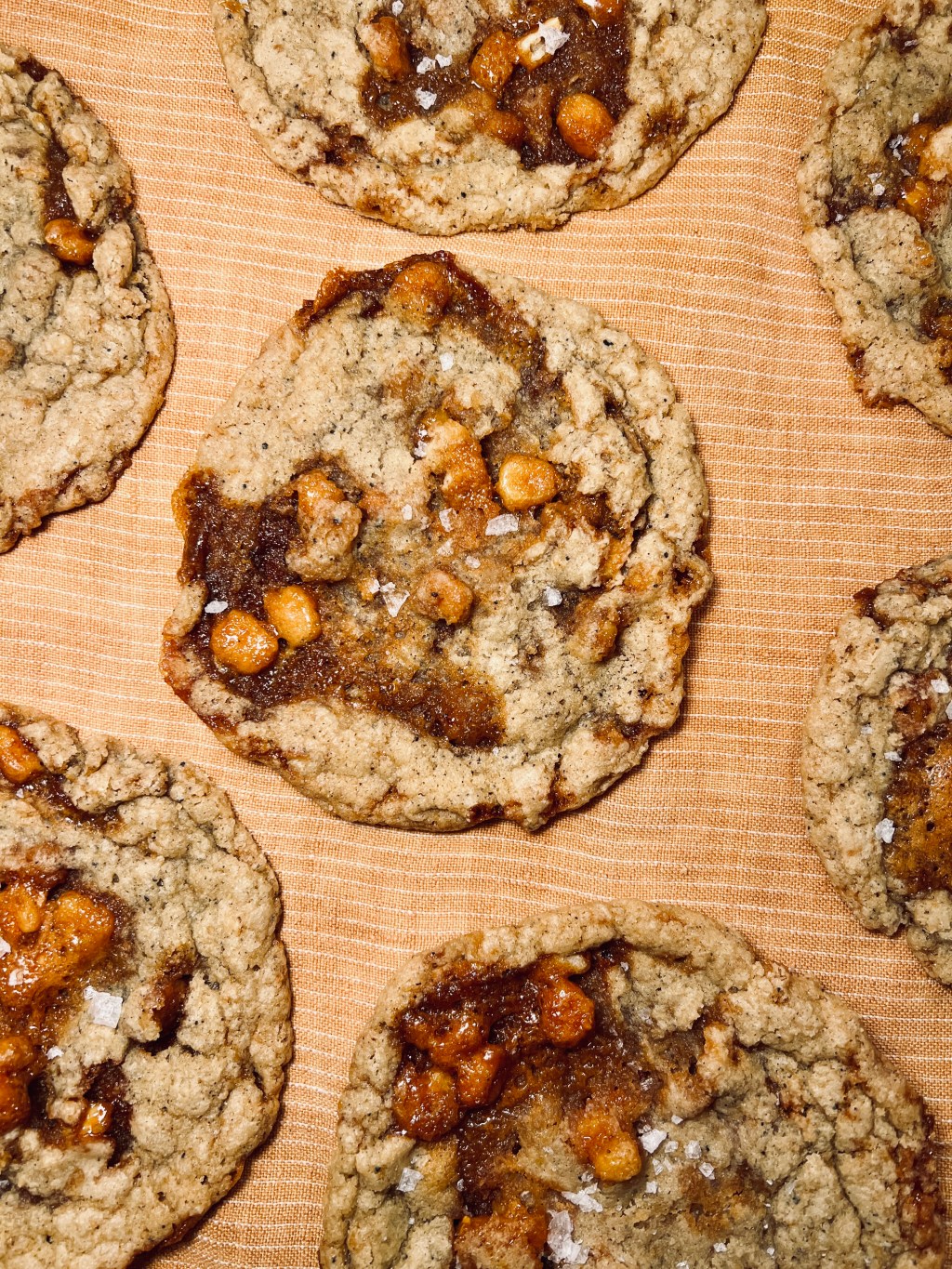
While this week’s post is indeed a recap of my experience making Molly Baz’s Corn Nut Brittle and Brown Butter Cookies, the journey actually started with a different cookie entirely. Specifically, it started with my very first foray into cookie recipe development.
One of my partner’s primary complaints is that he loves the cookie-part of chocolate-chip cookies, but he is not a fan of chocolate itself. Whenever I make chocolate chip cookies, the cookie tupperware will inevitably fill up with the remnants of his cookie excavation efforts: little chocolate nubs and crumbs galore. It drives me crazy.
Because his birthday was coming up, I thought it would be nice to make him a cookie he was excited about – all his favorite parts of cookies I’ve made in the past: brown butter, chewy texture, caramelized flavors, minus the chocolate chips.
I had never developed a recipe before, but I have watched a LOT of Bon Appetit test kitchen YouTube. How hard could it be? It turns out… not easy.
While I could have taken the easy route and simply made a classic chocolate chip cookie recipe and omitted the chocolate chips, I wanted to make a cookie that was my own. I also wanted to swap the chocolate chips for other mix-ins that my partner might actually enjoy as that would add more visual and textural interest to the final cookie.
Looking through my cookbooks, and the internet’s vast archive of so-called “best chocolate chip cookie recipes”, I found a few recipes to draw inspiration from:
- Christina Tosi’s Buttered Toast Cookies from All About Cookies
- Christina Tosi’s Compost Cookies
- J. Kenji López-Alt’s Best Chocolate Chip Cookies from The Food Lab
These recipes had a few components I was hoping to incorporate into my final cookie:
- Brown butter – very much a savory cookie staple, browning your butter is the best way to incorporate deeper, nutty flavors. Both the Buttered Toast cookies and Food Lab CC cookies use a method where you brown the butter and then cool it down until it resolidifies, allowing you to cream it so that you can incorporate more air into the cookie dough.
- Toasted flour – by toasting your flour on a baking tray for a few minutes until golden brown, you can add another layer of toasty flavor and depth – Tosi uses this method in her Buttered Toast cookies.
- Chewy texture – Food Lab CCC provides a very detailed breakdown as to the variables that go into a chocolate chip cookie – Kenji López-Alt cites butter incorporation methodology as a factor in cookie texture: creaming butter will result in a lighter, firmer cookie, whereas melted butter results in a denser, chewy texture.
- Mix-ins – Tosi’s Compost Cookies provided the most context as to how to incorporate mix-ins into your cookie dough that are of the non-chocolate variety (e.g. graham cracker crumbs, pretzels, potato chips, etc.)
For my first attempt, I started with a circus-cookie theme. My partner is a big fan of Animal Crackers, a snack we usually have around because it’s an ingredient in one of our favorite homemade mole recipes. He also loves kettle corn.
I created a frankenstein recipe, combining the three recipes I mentioned above, and hoped for the best. When I tasted the dough, I was optimistic. When I tasted the first batch of baked cookies, however, my hope began to deflate.
Visually, they were not the flat, wrinkly cookies I had envisioned. When I took a bite, the dominant flavor was baking soda. Upon further reflection, I decided I had either 1) accidentally added too much baking soda or 2) the baking soda I had added was a bit clumpy and I didn’t sift my dry ingredients resulting in pockets of baking soda distributed throughout the dough.
I was defeated. A whole batch of cookie dough wasted.
But, I picked myself up and went back to the drawing board. This time, I scrapped circus-cookies and drew inspiration from another one of my partner’s favorites: Quaker Maple & Brown Sugar Instant Oatmeal. This is his go-to breakfast, and I will admit that it smells amazing.
Sadly, we were departing from savory-cookie territory, but all in the name of love.
My first goal was to boost the textural and visual intrigue of the final cookie. When I looked at my source of inspiration, a few ideas came to mind:
- Oats – an obvious nod to instant oatmeal, but also an ingredient in Tosi’s Compost Cookies
- Maple pecan toffee shards – in my research, I had seen toffee and brittles as an add-in for cookies, and it seemed the best way to highlight the maple flavor
- Espresso powder – another ingredient in Tosi’s Compost Cookies, also playing on the breakfast theme
- Biscoff cookie crumbs – my partner’s go-to airplane snack, and an alternative to graham cracker crumbs, another ingredient in Tosi’s Compost Cookies
I kept the brown butter, subbed in some oat flour in addition to the toasted AP flour because I had some on-hand, and settled on a lower-baking temperature to achieve a wider, flatter cookie. I also bought a fresh box of baking soda, measured carefully, and sifted my dry ingredients.
The final cookie was a huge improvement compared to my first attempt. I topped it with homemade vanilla salt (who knew this was a thing!) and the maple pecan toffee achieved my desired visual effect. The cookies came out of the oven at just the right level of done-ness, allowing me to re-shape them with a cookie cutter to be more perfectly circular before they cooled completely, at which point they were definitely of the chewy variety. My partner was a big fan and ate these cookies with gusto, no excavation needed. Friends who I shared them with also gave rave reviews. It was a success!
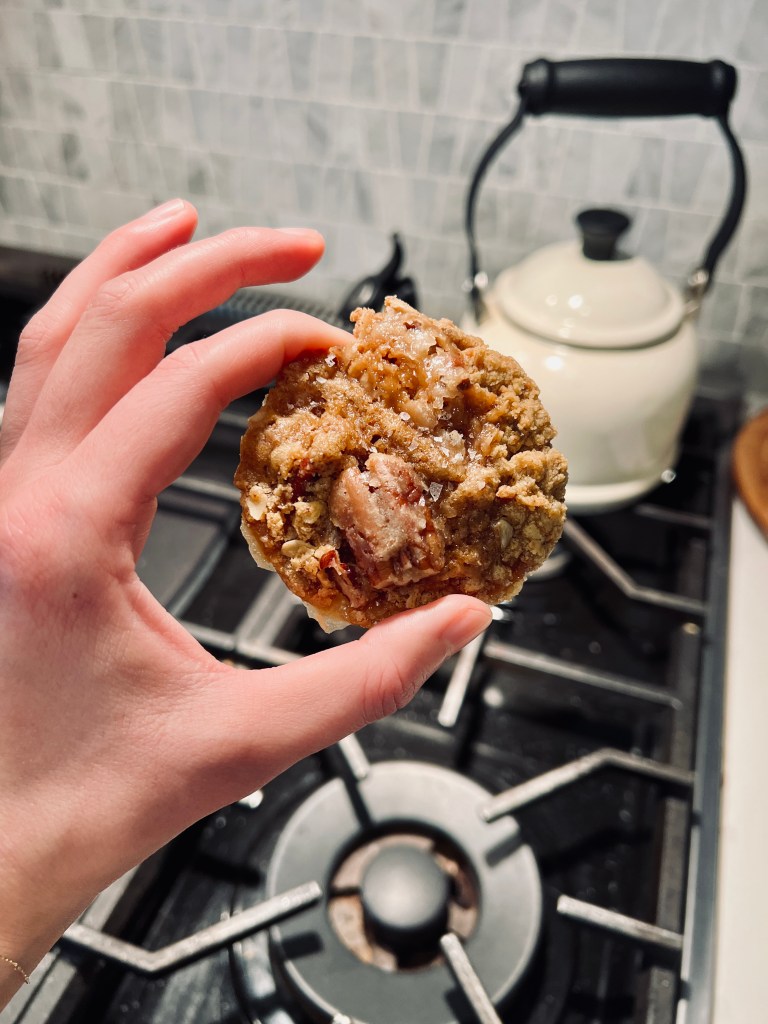
Still… it wasn’t perfect. I wanted a flatter, more wrinkly cookie. It was chewy, but could it have been chewier? While the mix-ins all worked together, I wondered if I had over-engineered this cookie. Was I trying to do too much?
This inspired me to look to other cookie recipes to see what I could do better next time. I loved the toffee/brittle concept – the melted caramelized sugar really makes for a sexy looking cookie. Maybe I should look for a recipe where that was the star of the show. Which is how I found myself looking at Molly Baz’s recipe for Corn Nut Brittle and Brown Butter Cookies.
I am a huge fan of Molly Baz. She is a certified bad-ass and a recipe goddess. I’ve followed her journey from Bon Appetit test kitchen to 2x NYT Bestselling cookbook author and am consistently surprised and impressed by her creations. Her approach to cooking (and baking) is articulated well in the title of her second cookbook: More is More. She loves to layer flavors and textures in her recipes. Her palette is bold, bright, herbaceous, and definitely savory. Her desserts follow suit – the title of her dessert chapter is “Sweets for Salt-Tooths” and the recipes feature ingredients like black sesame, ricotta, and a whole lotta flaky salt. Still, while her recipes are flavorfully complex, the techniques and methodologies applied are decidedly un-fussy and low-maintenance. She wants her audience to have fun in the kitchen.
In addition to her cookbooks, she has a recipe subscription club (The Club) which is where I found her Corn Nut Brittle and Brown Butter Cookies recipe. As soon as I saw the photo of the cookies, I knew they were exactly what I had envisioned when I set out to make my own cookie recipe. Picture: sugar-coated corn-nuts, speckles of brown butter, and amber rivers of melty brittle, pooling in the many crevices of a very large, flat, wrinkly cookie. Upon reading the first sentence of the recipe intro, I knew they were also a perfect fit for my project:
“If ever a cookie has towed the line between sweet and savory, it’s this one.”
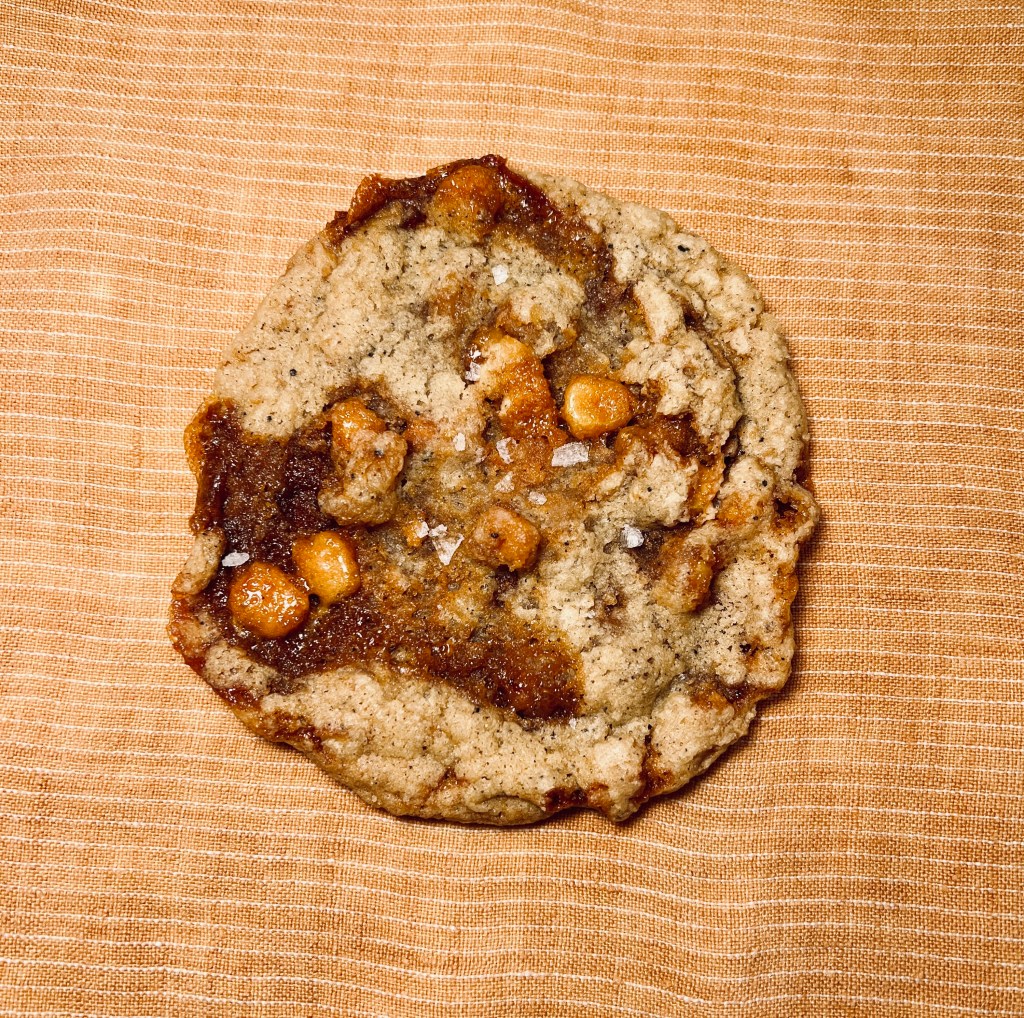
And boy do these cookies deliver. Their savory flavor comes primarily from the inclusion of the beloved gas-station snack: Corn Nuts®. Baz leans into the corniness of it all and swaps some of the flour for corn-meal and tops the whole cookie off with, you guessed it, flaky salt. As the title states, it also features brown butter, a sure-fire way to embody your cookie with another layer of savory-goodness.
This cookie was fun to make. The brittle is made honey-comb style by adding a pinch of baking soda to the molten sugar, resulting in a chemical reaction reminiscent of a school science fair volcano and leaves behind a beautiful orange, aerated brittle, studded with corn nuts. (Although I did set off my smoke detector by burning my first batch of molten sugar.. oops). The recipe calls for generous 2-oz mounds of dough. I felt like I was at an ice cream parlor as I scooped them out onto the baking tray. When you take the cookies out of the oven, you slam the tray down, instantly creating ripples and wrinkles across the surface. Finally, you carefully sculpt them into perfect circles with the edge of your spatula before they cool and take their final shape.
Everyone who tried the cookies loved them, and I understand why. The flavors and textures seem designed to satisfy the part of your brain that craves crunch and salt – the part that will have you reaching for that bag of Fritos or Corn Nuts as you check-out at the bodega.
As for my next recipe development attempt, I walked away with the following learnings:
- Keep it simple, stupid – while more can be more, there is a point where it becomes too much. If I were to make my Maple Brown Sugar Oatmeal cookies again, I’d focus more on the star of the show: the maple toffee, and lose some of the other add-ins (espresso, biscoff cookie crumbs)
- Make changes one-at-a-time – I did some research into recipe development after-the-fact, and one of the most common pieces of advice was to avoid changing too many variables at once. Like a science experiment, you won’t know what it was that made something better or worse when you change 5 different things in a recipe. As someone who isn’t quite ready to commit to the “make the same recipe 5 different times with gradual tweaks” lifestyle, from an ingredient cost, time, and food-waste standpoint, I do understand the rationale behind this advice and will strive to make fewer changes that I can more easily track the success of next time.
- Back to basics – there is a reason why many chefs and food professionals go to culinary school. Recipe development requires having foundational knowledge and skills so that you better understand the implications of the changes you are making. In developing my own cookie recipe, I realized I didn’t know the first thing about baking ratios, the difference between leavening agents, or the chemical reactions involved. I’ve since ordered some baking science books in an attempt to build my own base knowledge.
My biggest take-away is that recipe development is hard. While I already have immense respect for the chefs and food editors and many other talented people behind my favorite recipes, I didn’t realize just how complicated recipe development can be. Moving forward, I’ll be just that much more impressed when I find a recipe that is easy to make and delicious to eat.
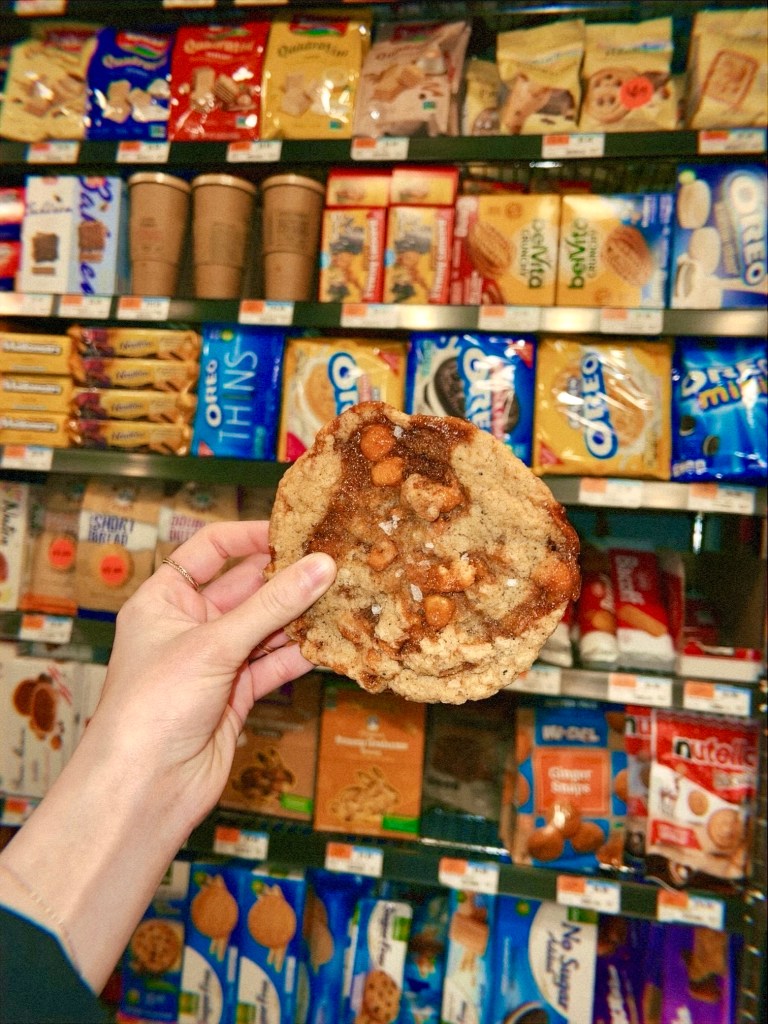
| savory-ness (1-5) | 4 – corn and salt and brown butter make this a decidedly savory cookie |
| weird or works? (complimentary flavors or a little bit weird?) | Works! Works! Works! |
| savory ingredients highlights | corn nuts + corn meal + flaky salt |
| best served… | did someone say munchies? |
| encore? | would risk setting my smoke detector off again to make these cookies a second time |

 Savor Tooth Snacks
Leave a reply to lessons in recipe development: salted duck egg yolk + guava jam sandwich cookies – Savor Tooth Snacks Cancel reply