
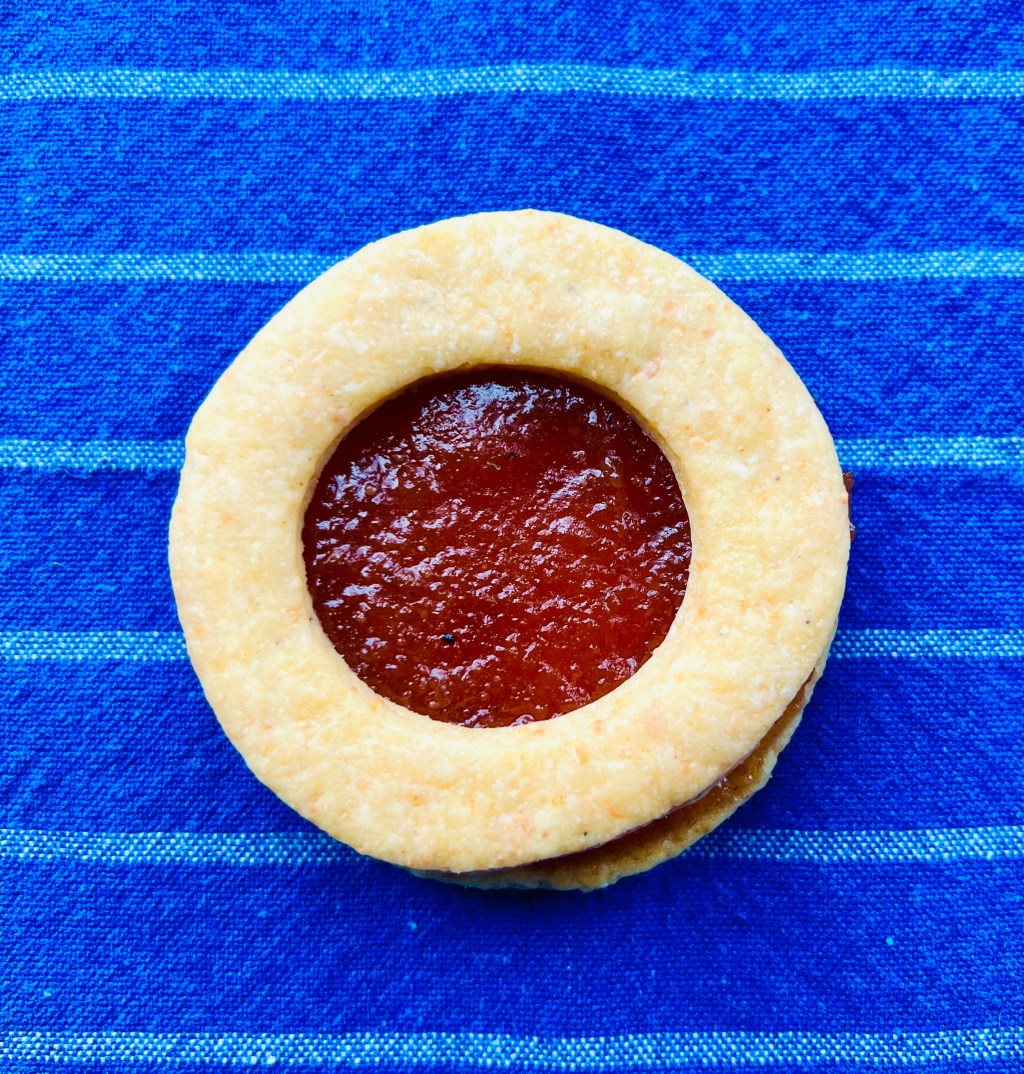
Feeling bolstered by the success of my first cookie recipe, I thought I would take on something a bit more challenging. I landed on a recipe from recipe developer/food stylist Jesse Szewczyk: Manchego Linzer Cookies with Quince Jam. This recipe can be found in Szewczyk’s cookbook, Cookies: The New Classics which aims to put a fresh spin on more traditional cookie recipes by introducing bold and unique flavors. The book was first on my list of cookbooks to buy for this project as it contains an entire chapter dedicated to the art of the savory cookie.
I wasn’t familiar with Szewczyk’s work until I started to dive into the world of the savory cookie. He was one of the first to develop savory cookie recipes that fell outside the “savory shortbread” realm – his cookbook includes savory biscotti, bar cookies, madeleine, and more. This stands out as savory shortbread variations make up nearly one third of the total recipes I’ve found (it makes sense, as shortbread provide an excellent blank canvas for all flavors, savory and sweet).
Granted, some of his savory cookie recipes are venturing towards potentially “weird” flavor territory – take his Parmesan Cheesecake Bars which feature garlic, a pungent and extremely savory flavor. But that’s what makes Szewczyk’s take on the cookie so refreshing. He isn’t afraid to try something that might not work – and in the process, he’s curated an entire collection of recipes that more timid baking minds may have never dreamed possible.
Listening to Jesse Szewczyk’s interview on the Taste podcast, I was able to gain more insight into his goals for Cookies: The New Classics and how he managed to reinvent the cookie 100 different ways. According to Szewczyk, the book was an attempt to make non-traditional, edgy flavor profiles more accessible by presenting them in a very accessible, universal format: the cookie. As a result, he was able to bring new life to a centuries-old culinary category and get people excited to experiment in the kitchen.
My favorite part of the episode was hearing about Szewczyk’s recipe development process. He described it as a sort of reverse process: he started by coming up with the idea and name for 100 unique cookie recipes, and then worked backwards to make them a reality. As someone who has never developed a recipe in my life, this process actually seems fairly intuitive to me – there is so much in a recipe name that it seems like a natural place to start when brainstorming a new concept. A recipe name is its identity: it highlights main ingredients and techniques and helps you visualize the end-product. A recipe name can evoke memories – while Szewczyk’s Everything Bagel Biscotti could just as easily be called a sesame seed, garlic, and onion biscotti, the former will call to mind thoughts of breakfast, smear, and crisp New York mornings. Also, it’s just more concise.
Of all the savory cookie recipes in Cookies: The New Classics, the one I was immediately drawn to was the one for Manchego Linzer Cookies with Quince Jam. Visually, they are a striking cookie: geometric and golden with a perfect hole in the middle through which you can see a glossy layer of red quince jam.
Side note – the imagery in Cookies: The New Classics is stunning. The pictures are dynamic and impeccably styled (unsurprising as Szewczyk is a food stylist by trade). Think cookbook meets coffee-table art book.

The recipe sounds straightforward. Very few ingredients are required (8, including salt and pepper), the dough comes together in a food processor. Roll and stamp the cookies, follow a clever hack to whip up a fast-and-easy quince jam, spread, sandwich, serve.
But boy, oh boy. These cookies were not easy.
But before we get into the struggles I encountered making these cookies, let’s talk about what makes them savory:
- Manchego cheese – the savory star of this cookie is a Spanish cheese called Manchego. Made from the milk of Manchega sheep (which live in La Mancha in central Spain), this semi-hard cheese is easily identifiable by its herringbone patterned rind and nutty, herbal flavor. Similar to parmesan and other semi-hard cheeses, manchego is a flakier variety of cheese, prone to crystallization.
- Paprika – the smoky, mild spice paprika, made from dried and ground red bell peppers, helps balance the salty cheese in the cookie. Paprika, specifically the smoked variety, can be found in many Spanish dishes as well, including Spanish chorizo.
- Freshly ground black pepper – fresh pepper also helps bring some spice and balance to the cookie, but also visual intrigue, creating a speckled effect in the dough.
- No sugar – I’ve seen other cheese-based cookie recipes, but many of them still include sugar. This cookie is more similar to a short-crust pastry in that it only includes flour and fat (in the form of butter and cheese). More on this later.
In addition to being unique in flavor, these cookies are also unique in format – they fall into the Linzer cookie family. Linzer cookies are a type of sandwich cookie originating in Austria. Traditional Linzer cookies consist of two almond-flavored cookies with a smaller hole cut out of the top cookie (referred to as a “linzer eye”) and a layer of jam (typically raspberry) in the middle. The result is a flavorful and festive cookie, often served around the winter holidays.
These Linzer cookies opt for quince jam to keep with the Spanish-tapas theme. Quince is similar to pear or apple, but unlike a pear or apple, is not typically eaten raw as it can be overly acidic and firm. While I did manage to find fresh quince at the bougie grocery store in my neighborhood (shout out to Greene Grape Provisions in Ft. Greene, Brooklyn), the recipe doesn’t require you to make jam from scratch. Instead, it recommends melting down membrillo, a Spanish quince paste, with a bit of water until it reaches jam consistency and using that to fill your cookies.
Now.. for the tea.
What I thought would be a chill, afternoon project turned into a multi-day saga that included a failed attempt, a broken oven, consultation of the King Arthur Baking Company baking hotline, and a redemption re-do.
My first attempt at making these cookies started out great – everything was coming together easily. I calculated ingredient measurements for a half-batch of cookies (when you make cookies every week, halving the recipe ensures enough cookies to taste but not so many that you don’t know what to do with them). The dough was easy to work with and roll-out, and the stamped out cookies looked just like the picture in the cookbook when I took them out of the oven. When I went to assemble them, however, the trouble started.
The recipe stated that after cooking, the warm cookies could be a bit fragile so it recommended leaving them to cool for a full 45 minutes before moving them or assembling. I ended up leaving them for several hours to go have dinner intending to come back and assemble after. As soon as I went to lift one of the baked cookies off the sheet, it immediately collapsed on the tray into a pile of crumbs. My initial instinct was to bake them for a few additional minutes, hoping it would solidify the cookie a bit further – it was at this point that I discovered the oven was no longer turning on.
Point of clarity – these cookies were not responsible for my broken oven. But the timing of it all did feel a little like the universe telling me that they didn’t want these cookies to happen. I did some creative problem solving and turned on the gas broiler (which was working) and popped the cookies on the lowest rack, trying to toast them up a bit more.
Once again wary of the recipe’s warning not to touch the cookies in their warm state, I left them overnight. I did not feel optimistic. I spent the evening racking my brain for what could have gone wrong and ended up waking up at 4 am to Google my running theories. The next day, I found the cookies were still INCREDIBLY fragile. The full-size cookies all fell apart, but I was able to salvage a handful of the mini ones I had stamped out of the leftover dough. I cobbled them together with the quince jam and used every bit of movie-magic I could to mask their state.
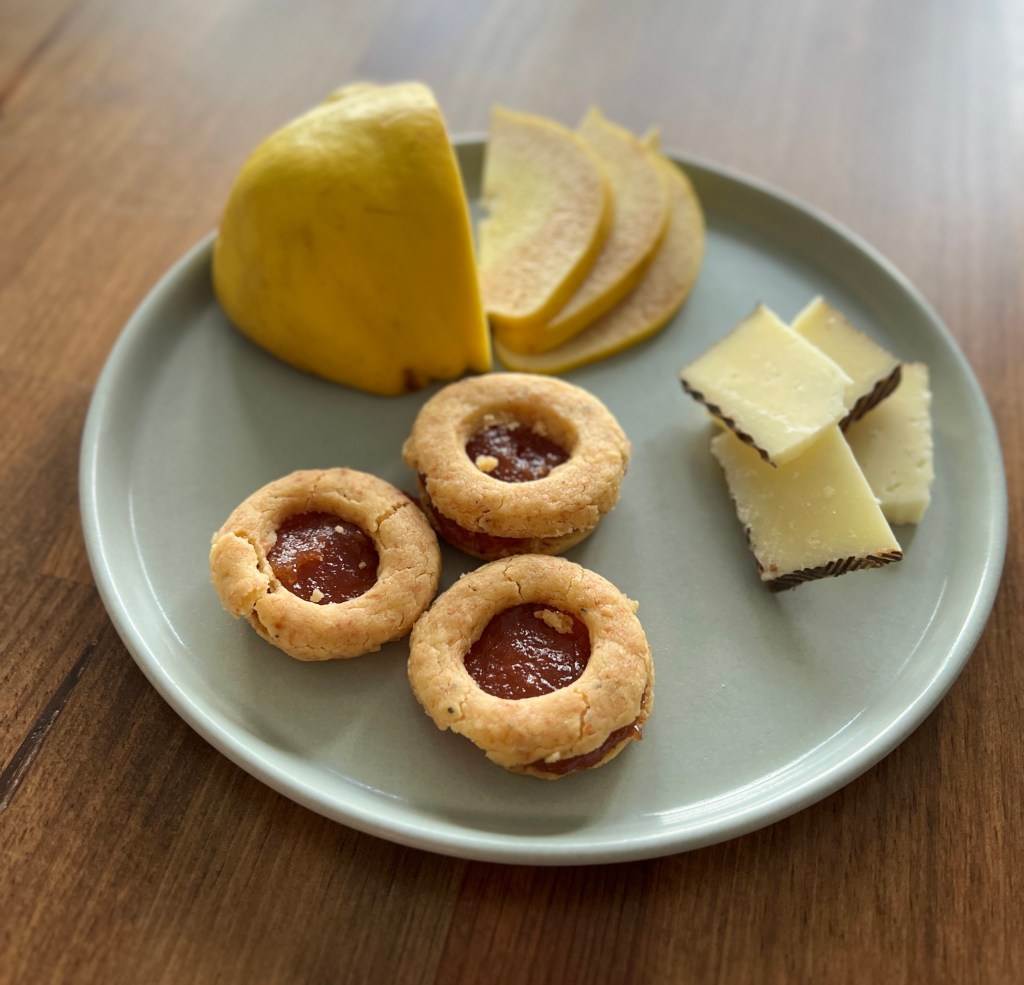

I was perplexed and disappointed. How did this happen? Should I try to make them again? What if I fail again? I needed to get to the bottom of what went wrong.
After some initial research, I came up with a few running theories:
Theory 1: cutting the recipe in half messed up the ratios & resulted in an overly crumbly cookie
This theory felt supported by the many adages I’ve heard over the years that baking is a science – measurements must be precise. Use a scale. Ratios of fat to flour matter. While I had meticulously calculated the correct half weight in grams per the recipe’s original measurements, maybe I got something wrong. The most obvious opportunity for error was the egg measurement: the recipe called for 3 egg yolks which doesn’t make for easy halving. I plopped in one yolk and eyeballed half of the other. Could that have been my fatal mistake?
Theory 2: these cookies lacked sugar and therefore lack structure
This theory gets a little into conspiracy theory territory. What if I hadn’t messed up the recipe… What if the recipe itself was bad? I really didn’t want to believe this could be the case – I respect recipe developers immensely and also assume they go through rigorous testing to make sure each recipe is foolproof. But… what if you have 100 cookie recipes to test? And some of those recipes are so obscure that they might never actually be made? Maybe some of those recipes go without as much scrutiny as the others…
This theory felt supported by the fact that I found only one other tagged photo of the same manchego linzer cookie on Instagram. Why weren’t people posting their creations? Was it because they too had also failed?
I had initially been surprised that the recipe didn’t include sugar – I had made a cheddar shortbread recipe earlier in the season that included a scant amount of sugar (a few tablespoons) and the final result was great. This recipe seemed similar, minus the sugar. Maybe that was the missing piece? I stumbled upon this blog post where someone recounted their own disastrous baking experience when they forgot to include sugar in a recipe that called for it. Their description of the cookie texture gave me deja vu:

“The cookies were SO fragile! They exploded with the slightest application of pressure”
This was my exact experience. Maybe this was the mistake. Could it be that a cookie recipe sans sugar was a recipe for crumbly, exploding cookies? Further research suggested that sugar helps provide structure and texture in a cookie – both things this first batch of cookies were missing.
However, adding sugar to a recipe that definitely doesn’t call for it felt like a pretty big departure from the original intention. While many savory cookies do include some sugar, this one decided not to for a reason.
I was left with no choice. I called in a lifeline: King Arthur Baking Company’s baker’s hotline.
I spoke on the phone with someone named David and explained my predicament and my current running theories. He was quick to debunk Theory 1 – halving a recipe, if done without error and using a scale for measurement, should not impact the final result. Particularly if that recipe doesn’t use leavening agents like baking soda or powder. I was relieved, but made note to do a more precise job of measuring 1.5 egg yolks next time, just in case that had been a factor.
David also felt dubious about Theory 2 – sugar can add moisture to a recipe, but its absence might not necessarily be the cause of my baking woes.
Instead, David offered up Theory 3: lack of moisture resulting in poor gluten development.
Essentially, he said that the problem seemed to be an abundance of fat and not enough water, resulting in an “overly short” dough – referring to shortcrust pastry dough which consists primarily of fat, flour, and water. When this happens, not enough gluten forms, resulting in insufficient structure and an extremely crumbly final result.
This theory felt like the most likely of the three. I thanked David and set out to remake the cookies, this time with a few slight modifications compared to the first round:
Modification 1: more precise measurement of egg yolks – I accomplished this by weighing one yolk and calculating the remaining amount needed to reach 1.5 yolks
Modification 2: addition of 2 tablespoons of water – David recommended this as a sure-fire way to encourage gluten development without straying too far away from the original recipe.
Modification 3: Processing the dough for the full recommended 35-45 seconds – the first time I probably only processed it for closer to 20 seconds and stopped when an initial dough formed. Underprocessing may have inhibited gluten development.
And…. it worked!
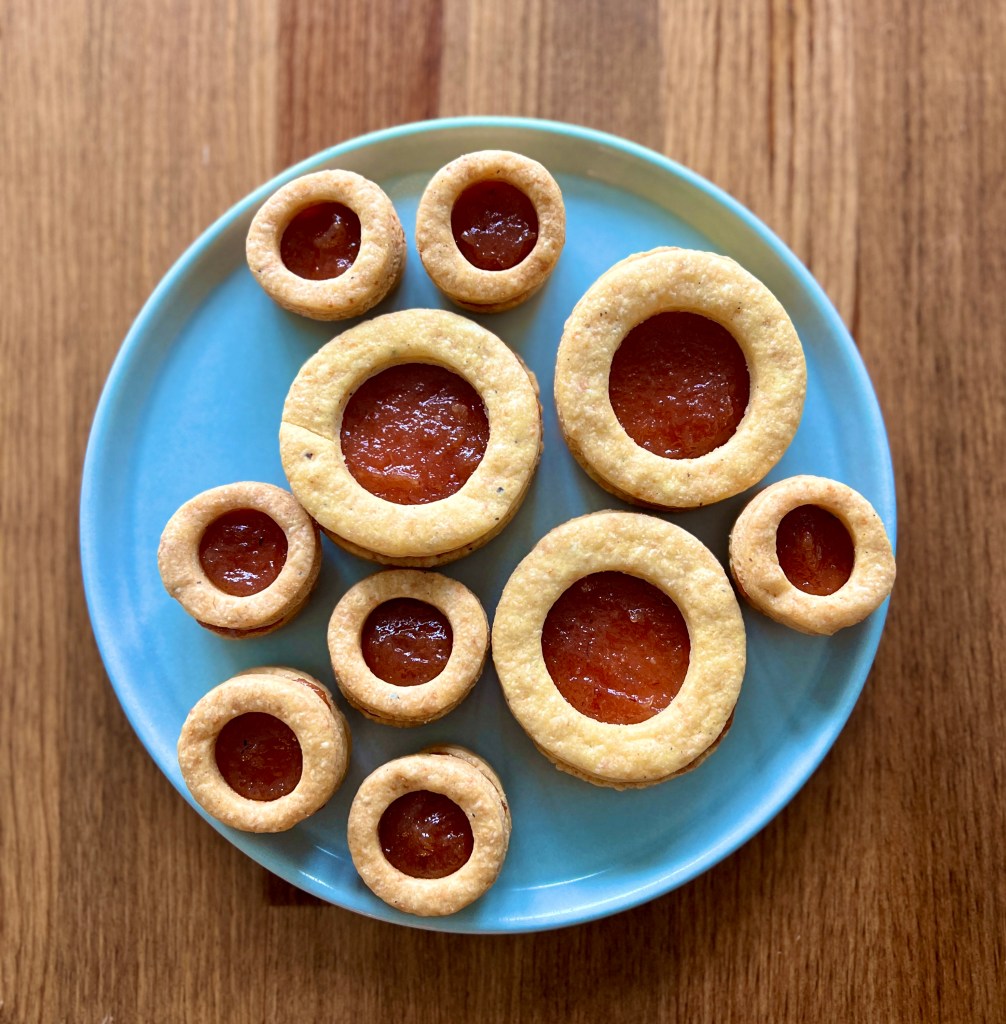
The cookies turned out exactly as I had originally expected. Still a light, buttery texture, but no longer falling apart.
The added structure helped me to appreciate the delicate flavor of the cookie more – I could better taste the manchego and the notes of paprika and pepper. It was a lot easier to assemble the final cookies as well – no longer requiring the precision and delicacy of a bomb-defusal. The pairing of quince and manchego in a cookie is a match made in tapas-heaven. Salty, cheesy, sweet, tart. The makings of a great savory cookie.
Overall, while this recipe did pose a greater challenge than initially anticipated, it was a good reminder of what this project is for: learning, experimenting, being more accepting of failure. I’m glad I had the opportunity to debug a failed attempt at a recipe. I learned a lot about baking that I otherwise wouldn’t have.
I also want to be clear that I don’t consider the recipe to be a bad recipe or Szewczyk to be a bad recipe developer. Baking is a science and the variance in outcome can be great. It’s possible that in the development process, adding water was unnecessary or second nature to those testing it. Maybe he used particularly large egg yolks that contributed sufficient moisture to balance the high ratio of fat. Maybe that 15 seconds of additional processing made all the difference and had I followed the recipe more precisely, my outcome would have been far better even without the addition of water. Between you and me, I don’t think we’ll ever know for sure as I have no intent of baking out all the possible variables J. Kenji López-Alt style (Serious Eats and Food Lab fans know what I’m talking about).

| savory-ness (1-5) | Cookie by itself: 4 Cookie filled with quince jam: 3 |
| weird or works? (complimentary flavors or a little bit weird?) | Works! Manchego and quince, it’s like a cheeseboard had a cookie baby |
| savory ingredients highlights | Manchego cheese + paprika + freshly ground pepper |
| best served… | With a glass of tinto de verano on a warm summer’s evening |
| encore? | Already made it again… because I messed up the first time. But in all seriousness, I would consider making these again now that I know how to ensure success. |


 Savor Tooth Snacks
Leave a reply to Elise Warnock Cancel reply