
This year I set out on a baking journey. I wanted to learn by doing and eventually start to experiment and build on that knowledge. I set some guard-rails to narrow my focus and, let’s be honest, maximize my chances at success. Cookies were the name of the game. Approachable and endlessly flexible. There are numerous formats and while some are indeed more challenging than others, the category definitively falls in the shallow end of the baking pool.
I’ve learned a lot the past year. I feel more confident navigating new recipes. I went from never having developed a recipe in my life to writing and publishing 6 cookie recipes this year. I can pivot when things go awry. And I even understand some of the basic fundamentals of baking science.
Still, it’s good to be reminded every once in a while that there is always more to learn. So, this year for Thanksgiving, I made a pie.
On its surface, the pie is every bit as approachable as the cookie. It’s familiar, nostalgic, a classic. However, unlike a cookie, pies have multiple components: the filling and the crust. This doubles your risk of failure. And while pies, like cookies, have many variations, the associated spectrum of difficulty is significantly wider.
On one end of the spectrum, you have the no-bake pie. Here you’ll find pudding-interiors and graham cracker crusts. If you can operate a food processor and a whisk, your chances of success are nearly 100%.
Once you leave no-bake land, however, you’ll find yourself cranking up the complexity. Maybe you make a lemon tart with a shortbread crust – easy enough, until your lemon curd splits in the oven and curdles into a soupy mess. Or maybe you try your hand at a laminated, buttery pie dough. Not only does it turn the entire venture into a multi-day affair (fingers crossed you get it right the first time), but your ability to gauge success is directly proportional to prior experience.
While cookbooks try their best to describe the optimal texture (pea-sized lumps of butter in the dough) or include hacks to make a recipe “foolproof” (freeze your flour! apple cider vinegar! use a food processor!), ultimately none of these can compete with the hard-won insights that come from trial and error.
Now, this is not to say that pies are particularly advanced bakes (if you ask the Great British Bakeoff, Bread Week is the most notorious). Many novice bakers make pies with minimal challenge to great success. That being said, if you are not precise or if you don’t trust the process, it’s very easy to make mistakes that send you back to square one.
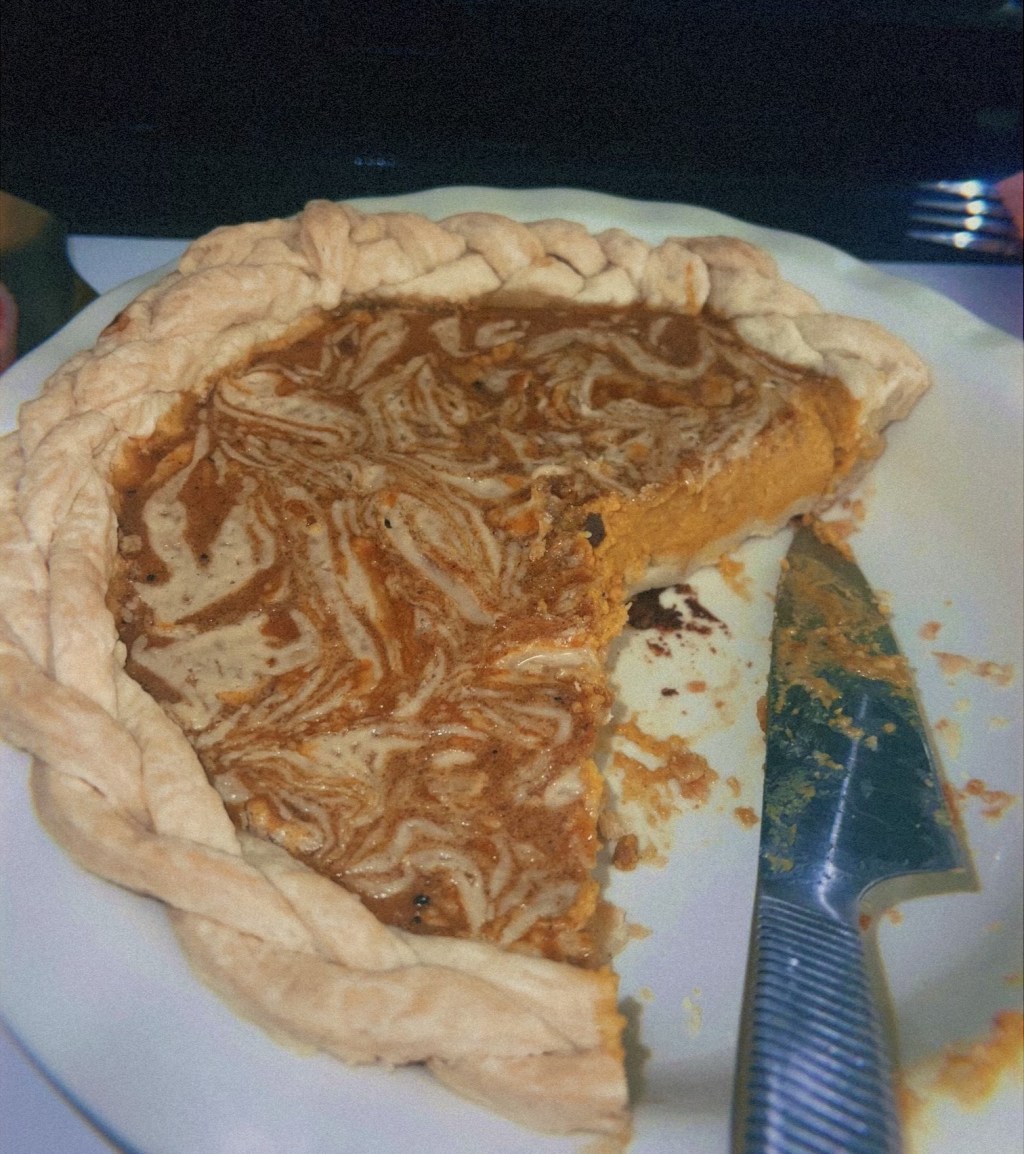
Which brings us to Thanksgiving 2024. NYT Cooking published a recipe right up my alley: Sesame-Swirled Pumpkin Pie. It felt fairly straightforward and while it’s been a minute since I last made a pie with a parbaked butter-filled crust (I believe the last time was in 2023), I figured “what could go wrong”. I used a pie crust recipe from a trusted source, decided to substitute all all-purpose flour instead of the blend between AP and pastry flour (what actually is pastry flour?) and used a food processor to bring the dough together. As I wrapped up the dough, I noted some larger pieces of butter that didn’t get properly distributed, but ultimately figured “what could go wrong” and put the dough in the fridge to rest and hydrate overnight. The next day, as I rolled out the dough, I realized that the larger pieces of butter were perhaps a bit too large. Still, I plowed ahead and put the crust in the oven, fingers crossed for the best.
A few minutes later, the smell of burning butter forced me to pull the pie dish from the oven, only to find a melted blob of oily dough collapsed at the bottom.
I stood for a moment as a familiar combination of panic and frustration rose in my chest. But then I took a deep breath. This was part of the process. This is how you learn from your mistakes.
If I had listened to my gut earlier on, I could have remade the dough or processed it further to break down the butter into smaller pieces. But, I didn’t, and this was the consequence. I pulled out a different recipe (one which only called for all-purpose flour) and re-made the dough, meticulously cutting the butter into pea sized cubes first before incorporating it into the flour by hand.
Fortunately, I had the foresight to make the first batch of dough on a Tuesday with the intent of baking the pie the day before Thanksgiving. This left sufficient time to recover from disaster and still have a finished pie on the table.
The second round of dough was by no means perfect but it held its shape. I even tried my hand at a braided crust which, while lopsided, looked festive. The final pie had some flaws – it was slightly underbaked and the sesame-swirl, while a fun twist, wasn’t anything to write home about. But, there was still pumpkin pie at Thanksgiving dinner and I walked away with some knowledge to boot. And for that, I’m thankful.
 Savor Tooth Snacks
Leave a comment