
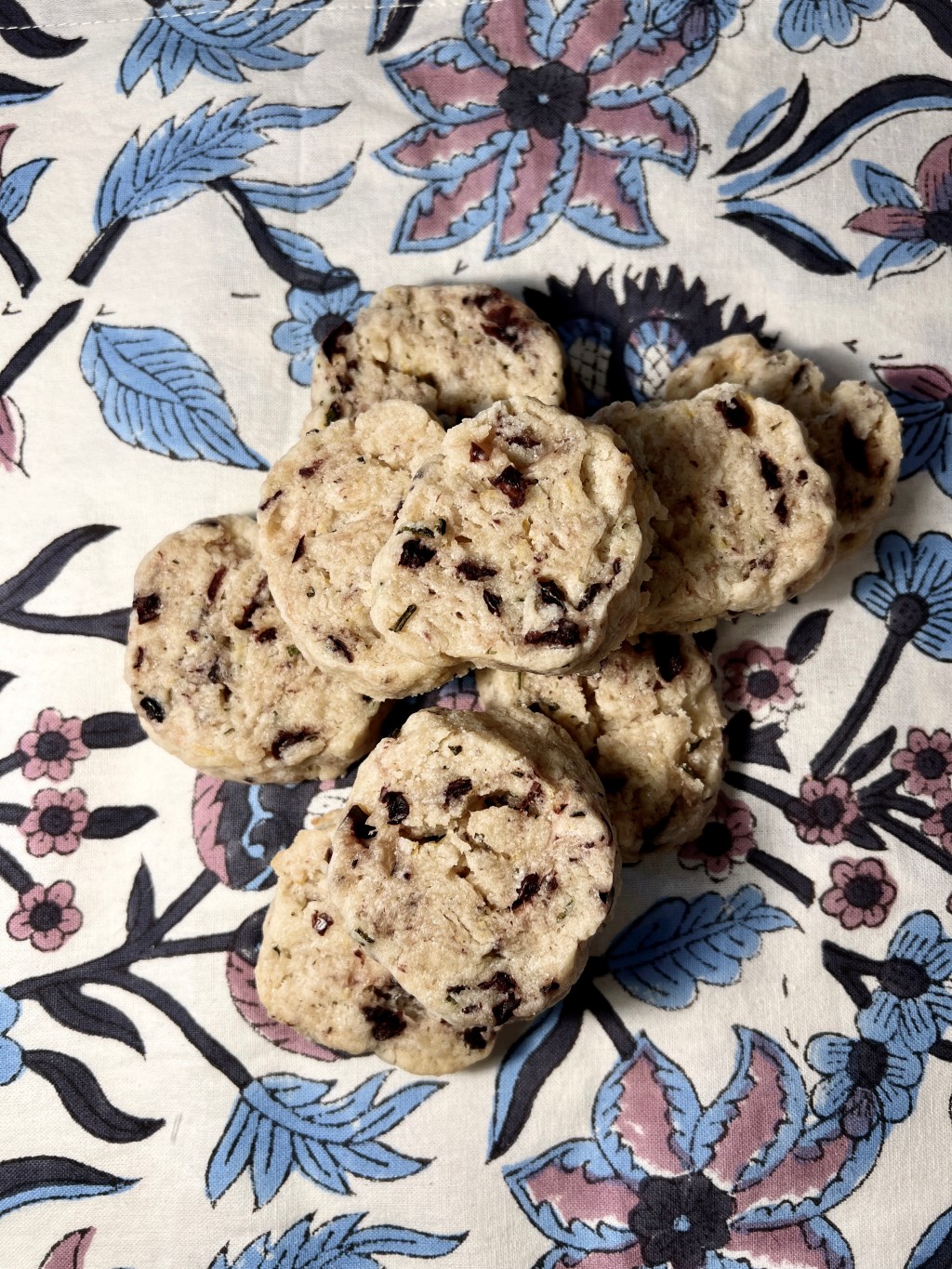
In my search for decidedly “savory” cookie recipes, I did have some preconceived notions as to the sorts of ingredients I would find. I expected the obvious: cheeses, herbs, salt, and spices. I expected umami-forward ingredients like miso or ingredients that impart toasty, nutty flavors like brown butter, sesame oil, tahini. I even expected the odd savory extreme (garlic?). One that I didn’t see coming, however, was olives. Enter: Yewande Komolafe’s Savory Shortbread Cookies with Olives and Rosemary from NYT Cooking.
I am a big fan of olives, however, that hasn’t always been the case. Olives are part of a polarizing set of foods – people either love them or hate them. Other foods in this set include things like oysters, anchovies, mushrooms, or brussels sprouts. These are foods that have strong flavors, unique textures and, in many instances, correlate with a distaste formed during childhood. Many people, including myself, may find that they eventually overcome their revulsion towards these types of food over time.
There are many reasons why this might be the case. For some, it’s due to a change in taste: your palate becomes more adventurous thanks to travel and exposure to new cuisines. Some chalk it up to literal change in taste: as you age, your sense of taste shifts due to the gradual loss of taste buds. I do think both of these are contributing factors. But there is another variable that I think might play the biggest role of all: how you prepare these foods can make a world of difference in whether or not you enjoy them.
Take brussels sprouts, for instance. A classic case of mis-preparation induced disgust. Even today, with my diminished taste buds and a greater appreciation for vegetal, bitter flavors, if you were to serve me boiled brussels straight up, I would struggle to eat them. However, if you throw them under a broiler until they are charred, dress them with balsamic, and toss them with bits of pancetta? I’ll devour the entire platter.
Composition matters. An ingredient can’t shine unless you honor it by preparing it to be the best version of itself. You have to think about ways you can introduce textures that people enjoy (more crunchy, less slimy) or serve it with something complimentary to ensure a balance of flavors. Sweet to balance salty, spice or citrus to brighten up something heavy or bitter.
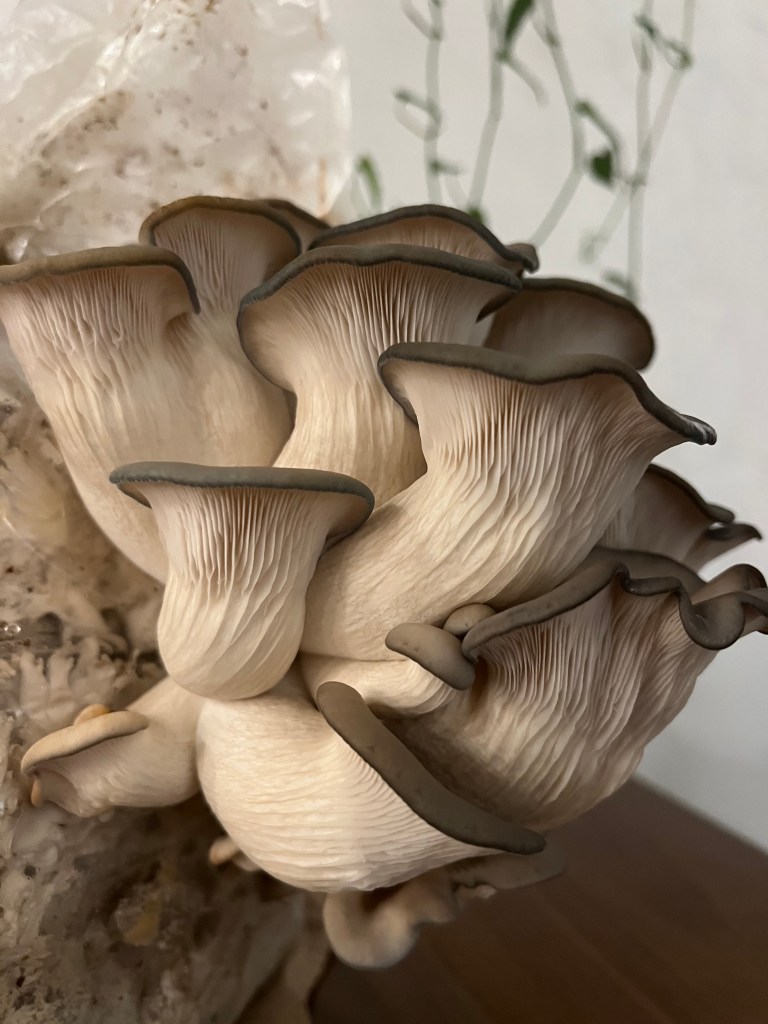
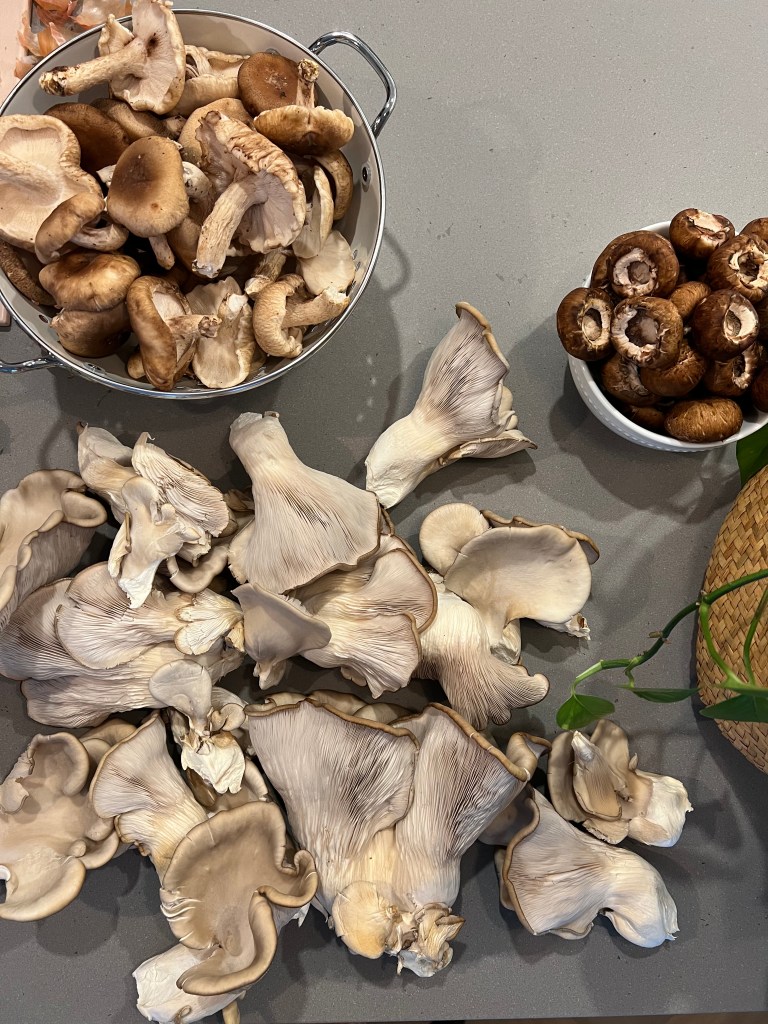
Quality and variety of your ingredients can also change the game. For so long, my association with mushrooms was the kind you might find on a run-of-the-mill pizza: baby bella mushrooms, thick slices, with a texture similar to craft foam. It wasn’t until later in my life that I realized mushrooms could be so much more than an ingredient in canned soup. There was an entire world of different fungi, each with unique shapes, textures, and flavors. I went foraging in the hills of California and learned about candy caps, chanterelles, and black trumpets. I’d see new varieties at farmer’s markets and specialty grocers: maitake, lion’s mane, morels. I grew my own blue oyster mushrooms from scratch and marveled as they sprouted overnight until they were nearly the size of my head.

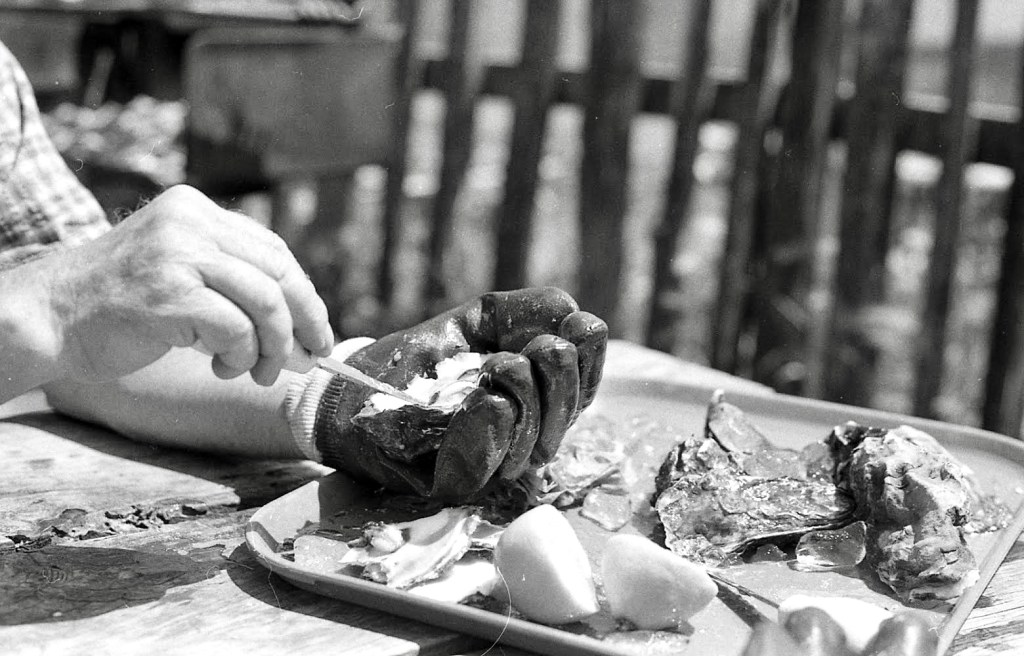
Sometimes, it’s less about the flavor itself, and more about the memory or association you hold for a certain food. Growing up, I didn’t have a preference for or against oysters because I never really tried them. One of the first times I had oysters, however, was with my dad on a road trip through Northern California. We drove up through San Francisco and hiked Muir Woods. We went to Mendocino and Fort Bragg where my dad reminisced about the days when he lived in Eureka and went clamming on the beach. On our way back south, we went wine tasting in Sonoma, stopped at Lagunitas Brewery in Petaluma, and finally made our way to Hog Island Oyster Company in Pt. Reyes. We bought two dozen oysters and my dad showed me how to shuck each one, minimizing the amount of shell left behind, and then carefully cutting the oyster away from the bottom so that you could throw it back in one gulp.
This memory brings me joy and certainly contributes to my love for oysters today. When I eat them, I am taken back to that moment on the water, enjoying some quality time with my dad. Food and memory are closely intertwined (read my thoughts on this here) and the context in which you are introduced to a new food can certainly color whether or not it becomes something you enjoy eating.


Now, back to olives.
While I was surprised to see olives in a cookie, it wasn’t actually the first time I had seen olives in a dessert. Molly Baz took the concept of an olive oil cake to an extreme with her Upside Down Olive (Oil) Cake, baking sugar-coated Castelvetrano olives straight into the cake. She assures her readers that the buttery, mild flavor of Castelvetrano olives is actually well suited for dessert (although, having not made the cake, I’ll have to take her word for it).
Yewande Komolafe’s recipe, however, features a much more potent olive: Kalamata. These burgundy-colored olives have a complex, deep fruit flavor, almost wine-like in nature. Kalamata olives are typically served in a savory context, alongside feta cheese or baked into bread with sundried tomatoes. In these cookies, however, these are paired with a few other ingredients to balance things out:
- Lemon zest – the most effective way to incorporate citrus flavors into a baked good without worrying about wet:dry ingredient ratios. Lemon zest brings a bright note in contrast to the richness of the Kalamata olives.
- Rosemary – one of the woodier herbs, rosemary is commonly found in savory applications from steak to focaccia. It lends a pine-like aroma and taste which compliments the lemon and olives nicely.
These cookies come together quickly, equipment optional (although lesson learned: I didn’t break down the butter into sufficiently small pieces when I did it by hand, so I will be utilizing a food processor next time). They are of the slice-and-bake variety, so each cookie is its own mosaic, dotted with olive chunks, speckles of rosemary, and lemon zest.
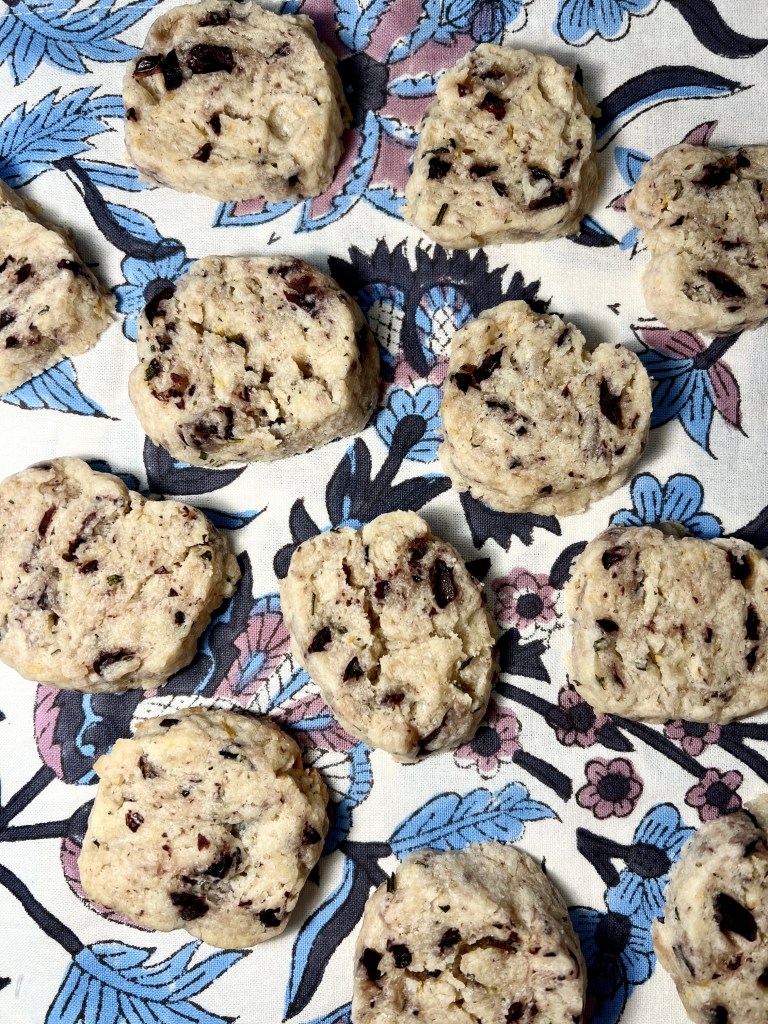
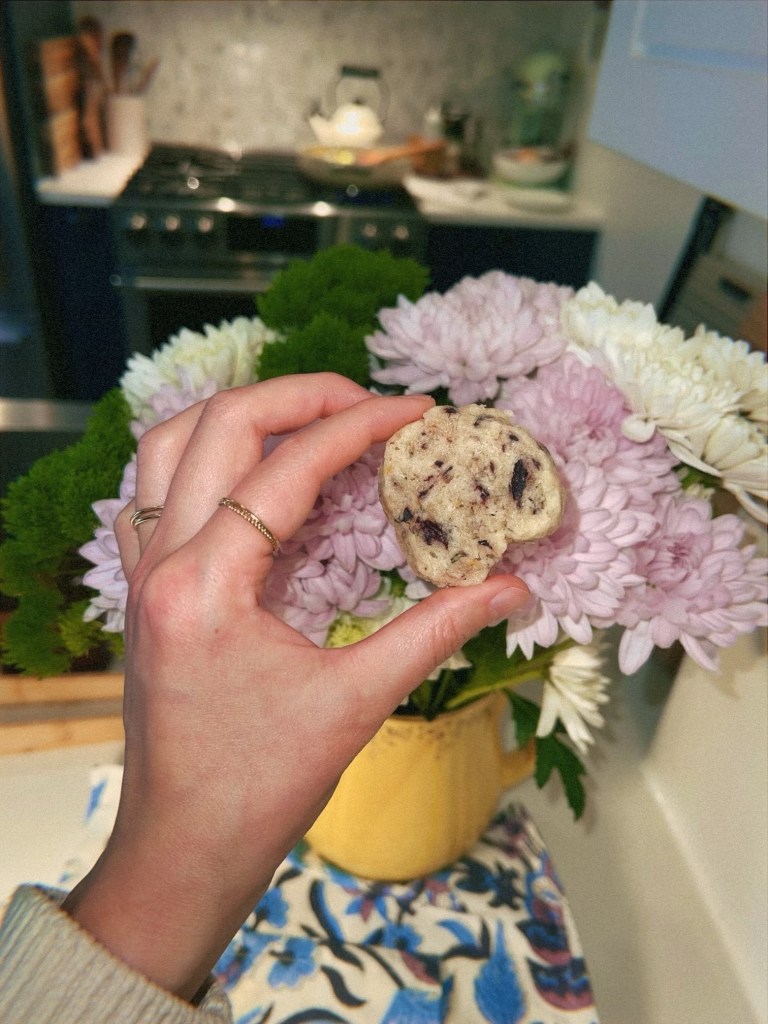
I was not sure what to expect when I tasted them. Komolafe compares them to chocolate chip cookies, but I was skeptical that an olive could taste like chocolate. However, when I tried them, they didn’t scream “olive” nearly as much as I anticipated. There was a slightly salty, fruity note, but with the combination of buttery shortbread, lemon and rosemary, these cookies surprised me.
“if a chocolate chip cookie and focaccia had a baby”
When I brought them to work, my coworker found the best way to describe their complex flavor profile, saying the cookies tasted as if “a chocolate chip cookie and focaccia had a baby”. The combination is a little confusing, but also delicious in a way that keeps you coming back bite after bite to figure out what exactly is going on. In short, these cookies are perplexingly addictive.
I tried to get my partner to taste-test the cookies, but he resisted. On the olive-appreciation spectrum, he is decidedly on the “hate ‘em” side. Fortunately, this works out well for the two of us: more olives for me, and he doesn’t have to leave anything behind. When I tried to explain that the cookies really didn’t taste like olives and that he actually might enjoy them, he looked at me with a sad expression and confessed that he didn’t want to have his perspective changed on olives because then our olive-compatibility would be broken. This sentiment was simultaneously heartwarming and heartbreaking.
Eventually he caved and ate the cookie. He said it was “okay” and that he couldn’t get over the fact that while it didn’t taste like olives, he knew they were in there. I suppose some aversions cannot be cured. Or he simply wanted to save all his olive-futures for me… we’ll never know for sure 😉
| savory-ness (1-5) | 3 – olives bring some brine, but not nearly as much as expected |
| weird or works? (complimentary flavors or a little bit weird?) | works! |
| savory ingredients highlights | kalamata olives + rosemary |
| best served… | when you are craving both a chocolate chip cookie AND focaccia |
| encore? | I’d do it olive-over again! |
 Savor Tooth Snacks
Leave a comment